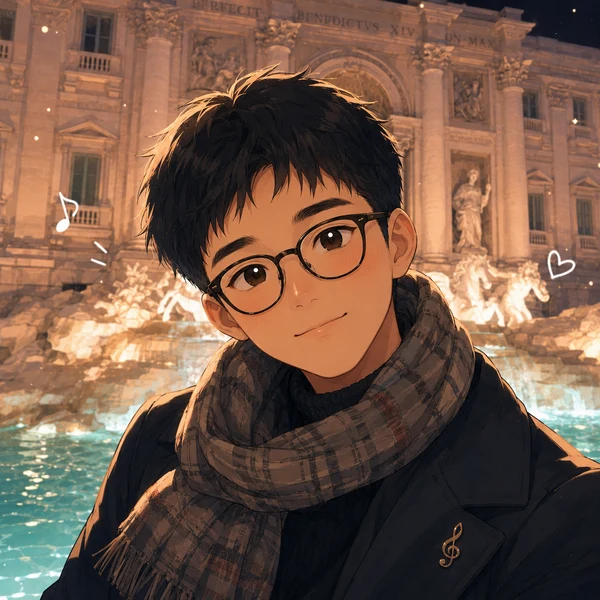





你好呀,我是 巫伟鑫(Wu Weixin)!
四岁那年赖在钢琴边不肯走,后来干脆把这份“赖”熬成了饭碗 —— 如今是个作曲家、音乐学者,还是个总想把课讲得冒热气的高校老师。要给我的日常画张像,大概就三样东西:五线谱、一堆代码,和对中国传统音乐怎么也问不完的十万个为什么。
🎯 研究与创作方向
作曲与作曲技术理论 · 中国传统音乐研究 · 计算机音乐 · 人工智能与音乐 · 高校音乐教学
🎹 一路走来
四岁摸上钢琴,2009 年趁课余偷偷自学作曲,2011 年正式拜师、一头扎进传统作曲 —— 师从旅法青年作曲家、星海音乐学院 王珂琳 教授,和声则跟着 廖明 教授学。
2012 年考进 广州星海音乐学院 电子音乐作曲方向,主课老师是来自美国的现代电子音乐大师 James Harkins 博士。备考硕士那阵,又贪心地同时跟中国现代音乐泰斗 曹光平 教授磨传统作曲、跟国家二级作曲家 李方 教授学配器。
2016 年从星海毕业,揣着录音艺术(电子音乐作曲)学士学位。同年我拎起行李飞去意大利,考进了普契尼的母校、全意大利排名第一的 米兰音乐学院 —— 还成了这所学校近几十年作曲硕士里唯一的中国面孔。师从威尼斯双年展奖得主 Gabriele Manca 教授与 Sonia Bo 教授,电子音乐主课跟着 Giovanni Cospito 教授钻研 Max/MSP 的音画交互,专业课连着两年考了满分。
2019 年签了索尼旗下的 Believe Digital(巴黎),放出第一部实验电子作品 Tramandò(传承) —— 我把曾侯乙编钟的声音,和自己攒出来的三分损益律合成器搅在了一块儿。同年七月,一首满是中国味儿的长笛独奏 《水调歌头·中秋》 在意大利首演,由 MDI 乐团长笛首席 Sonia Formenti 吹响,拿下 28/30 的高分,后来还录成了专辑。
2023 年,我在 中国艺术研究院 泡了一整年,做中国古代音乐史访问学者,师从音乐研究所所长李宏锋研究员。
2026 年,我获得英国 利兹大学(University of Leeds) 艺术、人文与文化学院的全额博士奖学金(Arts, Humanities and Cultures PhD Scholarship),攻读作曲博士(PhD)学位。带着这些年攒下的声音和故事,继续把音乐这条路走下去。
🧑💻 现在的我
最近最上头的事,是天天跟 AI 和代码“过招” —— 我一个人捣鼓出了个面向中国传统音乐研究的 AI 平台 MUSGPT.CN:拿《中国音乐词典》喂出了个知识库,还给音乐学前辈黄翔鹏先生做了个能对话的“数字人”。盘算着,让全世界研究中国传统音乐的人,查文献、问学问都能更省心点。
📄 学术论文
- 五度相生律、毕达哥拉斯律与三分损益律命名考[J]. 黄河之声, 2022(21): 68–71.
- 音乐考古学视角下的中国古代音乐史著述改写探析[J]. 乐器, 2024(07): 86–90.
- 宋姜白石自度曲伴奏和声编配初探[J]. 戏剧之家, 2024(29): 65–67.
- An Innovative Study on Teaching Basic Music Theory in Chinese Higher Education Institutions[J]. Pacific International Journal, 2024, 7(6): 241–247.
🎼 作品
- 琴歌 《归否》(2021 · UPC 3616552953496)
- 实验电子 《中华之传承——曾侯乙的音乐故事》/ Tramandò(2021 · UPC 3616552953472)
- 长笛独奏 《水调歌头·中秋》(2019 · UPC 3615939822998)
- 早期作品:《C Major, Piano Sonatina》(2012) · 《Don't Leave Me Alone》(2015) · 《String Quartet in D Major》(2015 · 谱面)
Hi there — I'm Wu Weixin (巫伟鑫)!
I parked myself next to a piano at the age of four and never really left — then somehow turned that stubbornness into a living. These days I'm a composer, a music scholar, and a university teacher who just can't resist making lectures feel alive. If you had to sketch my day, it comes down to three things: staves full of notes, piles of code, and an endless list of questions about traditional Chinese music.
🎯 What I work on
Composition & compositional theory · Chinese traditional music research · computer music · AI & music · music education
🎹 The road here
I started piano at four, secretly taught myself composition on the side from 2009, and in 2011 formally dove into traditional composition — under Prof. Wang Kelin (王珂琳), a France-based young composer at the Xinghai Conservatory of Music, while studying harmony with Prof. Liao Ming (廖明).
In 2012 I was admitted to the Electronic Music Composition program at the Xinghai Conservatory of Music, where my main mentor was Dr. James Harkins, an American composer and master of modern electronic music. While prepping for my master's, I greedily doubled up — traditional composition with Prof. Cao Guangping (曹光平), a towering figure in modern Chinese music, and orchestration with Prof. Li Fang (李方), a national-level composer.
I graduated from Xinghai in 2016 with a bachelor's in Recording Arts (Electronic Music Composition). That same year I packed my bags for Italy and got into the Conservatorio di Milano — Puccini's alma mater and Italy's top-ranked conservatory — becoming the only Chinese student in its composition master's program in decades. I studied with Venice Biennale Award winner Prof. Gabriele Manca and Prof. Sonia Bo, dug into Max/MSP audio-visual interaction with Prof. Giovanni Cospito, and scored full marks two years running.
In 2019 I signed with Believe Digital (Paris) under Sony Music and released my first experimental electronic work, Tramandò — blending the voice of the Zenghouyi chime bells with a homemade synthesizer tuned to the Sanfen Sunyi (three-part) temperament. That July, my flute solo “Shui Diao Ge Tou · Mid-Autumn”, steeped in Chinese flavor, premiered in Italy — played by Sonia Formenti, principal flutist of the MDI Ensemble — earning a 28/30 and, later, a studio album.
In 2023 I spent a full year as a visiting scholar in ancient Chinese music history at the Chinese National Academy of Arts, under Researcher Li Hongfeng, Director of its Music Research Institute.
In 2026 I received a full PhD scholarship from the University of Leeds — the Arts, Humanities and Cultures PhD Scholarship — to pursue a doctorate (PhD) in Composition, carrying every sound and story gathered along the way. The music plays on.
🧑💻 What I'm up to now
Lately I've been happily wrestling with AI and code — I single-handedly built MUSGPT.CN, an AI platform for Chinese traditional music research: a knowledge base fed by the Dictionary of Chinese Music, plus a conversational “digital human” of the late musicologist Huang Xiangpeng. The dream is simple — to make chasing down sources and asking scholarly questions a little easier for anyone, anywhere, who studies traditional Chinese music.
📄 Selected papers
- On the Naming of Pythagorean, Five-Degree, and Sanfen-Sunyi Temperaments [J]. Song of the Yellow River, 2022(21): 68–71.
- Rewriting the History of Ancient Chinese Music from a Music-Archaeology Perspective [J]. Instrument, 2024(07): 86–90.
- A Preliminary Study on the Harmonic Accompaniment of Jiang Kui's Self-Composed Songs [J]. Home Drama, 2024(29): 65–67.
- An Innovative Study on Teaching Basic Music Theory in Chinese Higher Education Institutions [J]. Pacific International Journal, 2024, 7(6): 241–247.
🎼 Works
- Qin song “Gui Fou” (2021 · UPC 3616552953496)
- Experimental electronic “A Heritage Passed Down — The Musical Story of Marquis Yi of Zeng” / Tramandò (2021 · UPC 3616552953472)
- Flute solo “Shui Diao Ge Tou · Mid-Autumn” (2019 · UPC 3615939822998)
- Earlier works: C Major, Piano Sonatina (2012) · Don't Leave Me Alone (2015) · String Quartet in D Major (2015 · score)